The Allure of the Icon: Exploring the Lushentic Grade Replica of the Hermès Blue Jean Togo Birkin 30
In the world of high fashion, few objects command as much reverence, desire, and mystique as the Hermès Birkin bag. It is more than a handbag; it is a cultural artifact, a symbol of ultimate status, and, as some argue, a financial investment more stable than gold. However, its stratospheric price tag and the famously opaque process required to purchase one have created a vast and sophisticated ecosystem of alternatives. Among these, the "Lushentic" grade replica has emerged as a particularly intriguing player, offering the look and feel of the iconic design at a fraction of the cost. This article delves into the specifics of one such coveted combination—the Birkin 30 in Blue Jean Togo leather with palladium hardware—and examines the phenomenon of high-end replicas like it.
The Holy Grail: Understanding the Authentic Birkin 30
To understand the appeal of a replica, one must first appreciate the legend of the original. The Birkin bag was born from a chance encounter in 1984 between Hermès CEO Jean-Louis Dumas and actress Jane Birkin on a flight from Paris to London. The actress complained about the impracticality of her handbag, and Dumas sketched a design for a spacious, utilitarian bag on the airplane's sick bag . This practical origin story, however, belies the bag's transformation into a global emblem of wealth and exclusivity.
An authentic Birkin is not merely manufactured; it is crafted. Each bag is hand-made by a single artisan in France, a process that can take up to 48 hours. The artisans require a decade of training to master the craft, earning them the moniker "the surgeons of luxury handbags" . This level of craftsmanship and the use of premium materials are the foundational reasons for the Birkin's price and its enduring value.
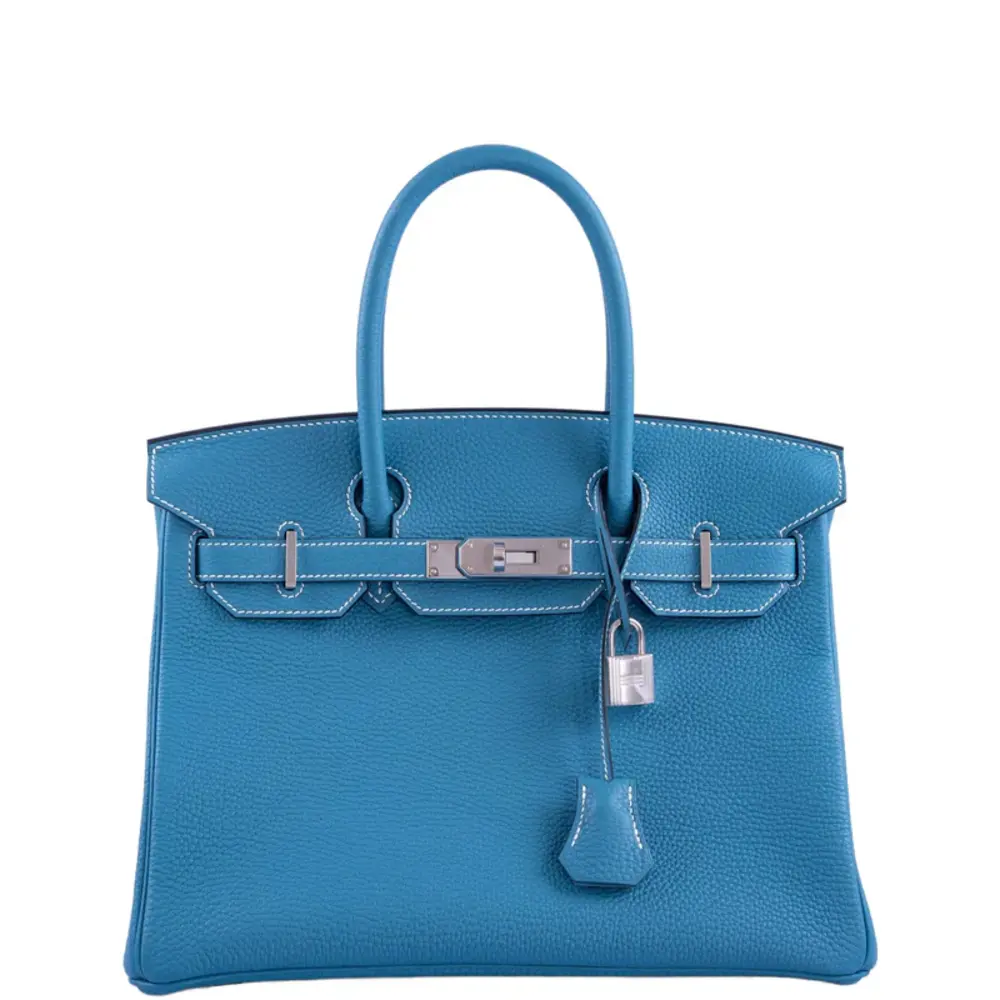
The specific model in question—the Birkin 30 in Blue Jean Togo with Palladium hardware—is a masterclass in subtle luxury. Let's break down its components:
The Leather: Togo. Togo is one of the most popular leathers used by Hermès, and for good reason . It is a calfskin leather named after the French "Togo" cowhide, renowned for its durability and distinctive, medium-sized grain. This pebbled texture is exceptionally resilient to scratches and everyday wear, making it an ideal choice for a practical yet luxurious bag. Furthermore, the leather has a remarkable ability to maintain its shape while remaining supple to the touch .
The Color: Blue Jean. The "Blue Jean" color is a favorite among collectors for its versatility. It is a saturated, vibrant medium-blue that is both casual and chic. The Blue Jean color captures the essence of denim but in a refined, upscale tone that can easily transition from day to night. On the secondary market, an authentic Birkin 30 in Blue Jean Togo with palladium hardware commands a price of over $35,000 USD , and special order or limited edition versions can cost significantly more .
The Hardware: Palladium. Hardware is a defining feature of a Birkin. While gold hardware offers a classic, warm look, palladium provides a cool, contemporary, and understated sheen. Palladium is a precious metal, a member of the platinum group, which makes it incredibly durable and resistant to tarnishing. This makes it a perfect complement to the casual elegance of the Blue Jean Togo leather, offering a modern and sleek aesthetic.
The Impossible Dream: Why Replicas Thrive
The inaccessibility of the Birkin is a core part of its mystique. Unlike most luxury goods, one cannot simply walk into a store and purchase a Birkin. Potential buyers must build a relationship with the brand, purchasing other items over an extended period to become eligible to be offered a "quota bag" . Even then, there is no guarantee of receiving the exact color, leather, or hardware one desires. This artificially maintained scarcity, while brilliant for the brand's image, has fueled a parallel market of high-quality replicas. The desire to participate in this exclusive status symbol, even in a simulated form, is a powerful driver. As seen with the "Wirkin," a $80 dupe sold at Walmart, the cultural cachet of the Birkin is so potent that even an obvious, low-quality copy can spark a global frenzy and sell out repeatedly .
The Lushentic Grade: A Cut Above the Rest
While the "Wirkin" represents the bottom tier of the dupe market—mass-produced, often using substandard materials and emitting a tell-tale chemical smell —a more refined ecosystem exists for those seeking a far closer approximation.
This is where terms like "Lushentic Grade" come into play. According to a widely referenced, albeit unofficial, grading system, "Lushentic" represents the pinnacle of the replica world . The description is almost mythical in its claims: bags are said to be crafted by artisans who previously worked in the original Hermès factories, using leather from the same suppliers and metal hardware sourced from the same production lines . While such claims are impossible to verify and are likely part of the marketing lore, they point to an important truth: these are not your average street-corner fakes.
A hypothetical Lushentic grade Blue Jean Togo Birkin 30 with palladium hardware would be designed to fool a discerning eye. The bag would aim to replicate:
The Leather: The pebbled texture of authentic Togo leather, its specific softness, and even its distinctive, natural leather scent (a key differentiator from the chemical smell of cheaper copies) would be the primary focus .
The Hardware: The palladium hardware would need to have the correct weight, engravings, and sheen. The iconic "H" cadena and the keys would be meticulously recreated.
The Craftsmanship: The most significant giveaway on any fake is the stitching. An authentic Birkin features saddlery stitching, a slightly angled stitch done by hand, not perfectly straight and uniform like a machine stitch. A Lushentic-grade replica would attempt to mimic this subtle imperfection . Similarly, the depth and clarity of the embossed Hermès logo would be a critical area of focus.
The Ethics and the Economics
The existence of such high-end replicas raises complex questions. For some, purchasing a replica is a practical, defiant act against a system that makes an object of desire nearly impossible to obtain, and it is a way to enjoy the design without the oppressive price tag or the arduous process of buying one . As one commentator put it, it's "the mob storming the castle saying 'We're here too, bitch'" .
However, the ethical and legal dimensions are significant. Counterfeiting is not a victimless crime. It can be linked to organized crime and, in some instances, even the financing of terrorism . It is also a direct threat to intellectual property rights; Hermès has a long history of aggressively protecting its designs and has won multi-million dollar lawsuits against counterfeiters . Furthermore, the "dupe" culture, to which this belongs, has been criticized for fueling over-consumption and the unsustainable practices of fast fashion .
The price point provides a stark contrast. An authentic Blue Jean Birkin 30 from a reputable reseller costs approximately $35,500 , while a "Wirkin"-style dupe can be found for under $100. A Lushentic-grade replica, per the unofficial guide, would occupy a middle ground, potentially costing $400 to $2,000, reflecting the far greater effort put into its construction .
Conclusion: The Shadow of a Legend
The Birkin bag's power lies in its dual nature: it is both an immaculate object of craft and an almost unattainable symbol. The existence of replicas, from the cheap and cheerful "Wirkin" to the meticulous and expensive "Lushentic" grade, is a direct consequence of this tension. They are a testament to the Birkin's unparalleled status in the fashion world, a shadow that the legend itself has cast. For every authentic Blue Jean Togo Birkin 30 with its precious palladium hardware sitting in a collector's closet, there are thousands of emulations, each a consumer's attempt to capture a sliver of that iconic, elusive magic. Whether this phenomenon dilutes the brand's power or simply reinforces its legend is a question that only time, and perhaps Hermès itself, will answer.


Comments
Post a Comment