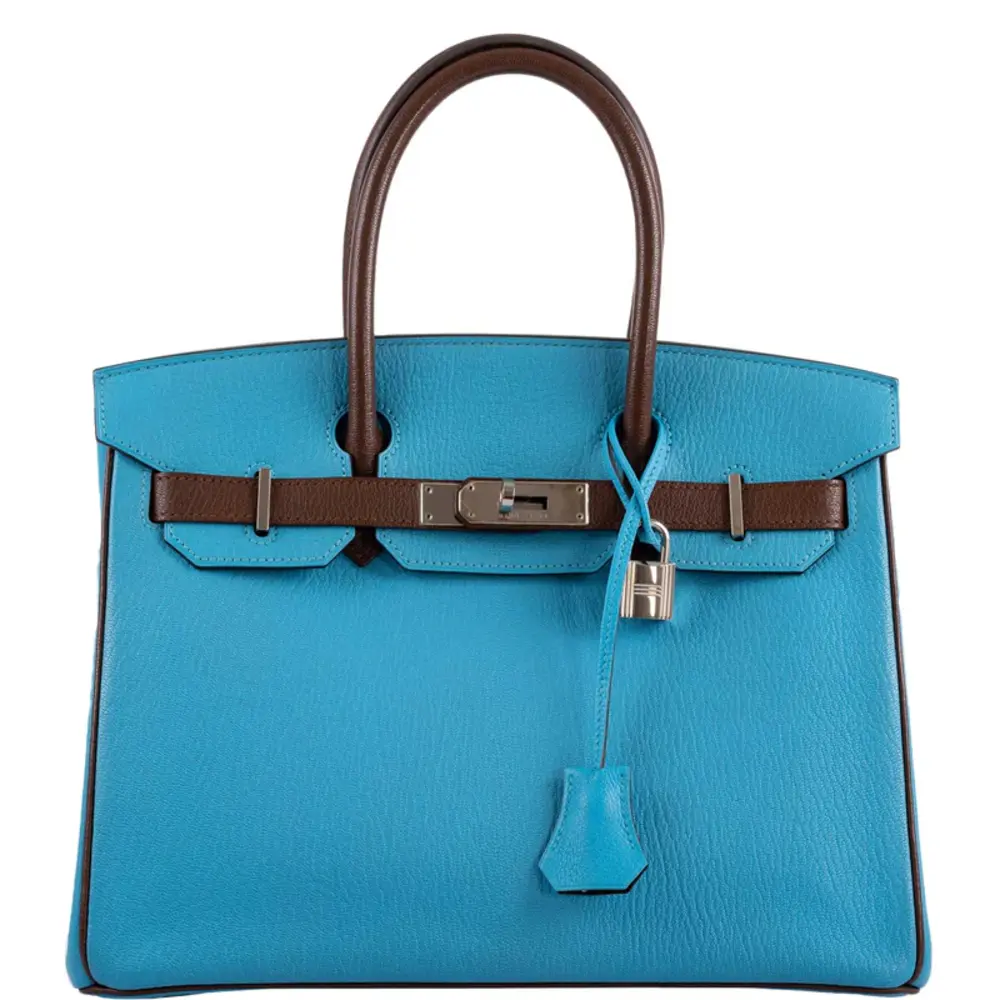
The Art of the Exception: Dissecting the Hermès HSS Birkin 30 in Bleu Aztec & Havane Chèvre Mysore
- Get link
- X
- Other Apps
In the meticulously constructed hierarchy of luxury handbags, few objects command the reverence, the speculative attention, or the sheer desire as the Hermès Birkin. It is the industry gold standard. Yet, within the pantheon of these iconic bags, there exists a tier so rarefied, so exclusive, that it elevates the accessory from a mere status symbol to a genuine work of functional art: the HSS (Horseshoe Stamp) Special Order Birkin. When this bespoke creation marries the vibrant, sun-drenched hue of Bleu Aztec with the deep, grounding richness of Havane, all rendered in the sumptuous and increasingly coveted Chèvre Mysore leather, the result is not just a handbag, but a masterclass in the art of personalization and craftsmanship.
The Language of the Horseshoe Stamp
For the uninitiated, the subtle details of a Hermès bag can be difficult to discern. However, for the connoisseur, the stampings on the bag tell the entire story. A standard Birkin features the iconic "Hermès Paris" stamp and a date code. An HSS bag, however, bears an additional, discreet mark: a small, embossed horseshoe stamp placed adjacent to the brand's logo . This unassuming symbol is the ultimate testament to a bag's origin; it signifies that the item was not a mass-produced piece from a boutique shelf, but a specifically commissioned, custom-ordered piece designed for an individual client.
The ability to place a Special Order—often referred to simply as an "SO"—is an exclusive privilege. It is an invitation extended only to the maison's most loyal and high-spending clientele, a reward for a long-term relationship cultivated with a specific sales associate . The process is shrouded in the mystique for which Hermès is famous. An invitation is not something one can demand; it is a marker of one's elite status within the brand's ecosystem. As one report from Sotheby's notes, clients often receive the opportunity once or twice a year, underscoring its scarcity . This exclusivity is the foundational reason why HSS bags command a significant premium on the secondary market, often fetching prices up to 50% higher than their non-special-order counterparts .
A Study in Contrasts: Bleu Aztec and Havane
The true genius of the HSS process lies in the ability to play with color and composition. While the 2025 Special Order palette included timeless neutrals and jewel tones , the real magic happens when a collector deviates from the monochrome to craft a bi-color combination that speaks with unique harmony. This is precisely where the pairing of Bleu Aztec and Havane shines.
Bleu Aztec is a vibrant, saturated turquoise-cyan. It is not a timid pastel but a bold and energetic tone, evocative of sunlit tropical waters. It sits in a distinctive slot within the Hermès blue spectrum, brighter than Bleu Atoll and cleaner than Turquoise . According to JaneFinds, this color has been produced in limited, cyclical allocations and has not seen sustained recent production, adding a layer of closed-supply scarcity to its desirability . This is a color that commands attention and embodies a spirit of joy and confidence.
Havane, by contrast, is the epitome of warmth and earthiness. It is a rich, milk-chocolate brown that has anchored Hermès's palette for decades . It reads as classic, refined, and understated. The combination of these two colors is a masterstroke of complementary tension. The cool, electric vibrancy of Bleu Aztec is simultaneously elevated and tempered by the grounding, natural warmth of Havane. In this configuration, Havane is often applied to the bag's trim, including the handles, sangles (straps), and piping, allowing the Bleu Aztec to dominate the main body of the bag. This creates a visual architecture where the vivid blue is given a structured frame by the deep brown, ensuring the bag feels both bold and sophisticated, whimsical yet timeless .
The Chèvre Mysore Canvas
A color combination, however striking, is only as good as the canvas upon which it is painted. For this specific HSS Birkin, that canvas is Chèvre Mysore, a leather choice that is itself a hallmark of discernment and exclusivity. Chèvre Mysore is a fine-grained goatskin, distinct from the older, larger-grained Chèvre de Coromandel . It is a leather that is notoriously difficult to work with due to its thinness and delicate nature, resulting in Hermès producing it in far more limited quantities than standard calfskin leathers like Togo or Clemence .
The properties of Chèvre Mysore make it the ideal vehicle for a complex, high-contrast color design. As noted by Privé Porter, Chèvre absorbs Hermès pigments more vividly than most calf leathers, leading to a superior color saturation . This means that the electric Bleu Aztec and the deep Havane would appear exceptionally rich and luminous on the surface of this bag. Furthermore, Chèvre is remarkably lightweight, helping the Birkin 30 retain a manageable weight, while simultaneously being highly scratch-resistant—a crucial feature for maintaining the flawless finish of a light-colored exterior . The leather is also structurally firm, allowing the bag to hold its distinct shape and crisp Sellier-style lines over time without slouching . The finishing touch is often Palladium hardware, a cool silver-tone metal that complements the cyan body without competing with its vibrant energy .
A Collector's Gem and Secondary Market Dynamics
The Bleu Aztec and Havane HSS Birkin 30, particularly a pre-2015 "O" square stamp model, represents a category of object that is rapidly becoming a prized artifact in the collecting world . Since 2017, Hermès discontinued the tri-color Special Order option, and there have been consistent reports of changing availability for certain sizes and leathers, such as the removal of Birkin Sellier 25 and 30 from the special order list . This means that existing pieces from specific eras, in leathers like Chèvre, with discontinued color combinations, are no longer replicable through the current boutique system, creating a "closed-supply premium" .
On the secondary market, HSS bags represent a distinct subset of auction sales, making up between 10% and 15% of all leather Birkins and Kellys at auction . While the general market trend favors neutral color combinations for the highest average premiums, the market for vivid bi-color Chèvre pieces remains robust, appealing to the elite collector building a dedicated color-driven archive . The combination of a rare leather, a striking discontinued color pairing, and an iconic size (the Birkin 30 is a perennial favorite for its perfect balance of capacity and elegance) ensures that this bag is not just an accessory, but a blue-chip investment and a true collector's grail.
- Get link
- X
- Other Apps


Comments
Post a Comment