The Birkin 25 Nata Ostrich with Polished Gold Hardware | The Pinnacle of Exotic Luxury
- Get link
- X
- Other Apps
In the rarefied world of haute couture, few objects command the reverence, desire, and investment potential of the Hermès Birkin bag. It is not merely a handbag; it is a cultural artifact, a masterpiece of craftsmanship, and a symbol of ultimate exclusivity. Within this stratosphere of luxury, certain combinations ascend to legendary status, and the Birkin 25 in Nata Ostrich with Polished Gold Hardware is unequivocally one such zenith. This bag represents the perfect alchemy of a coveted size, an exceptionally rare and delicate exotic leather, a sought-after neutral hue, and the warm glow of precious metal, creating an object that is as much a work of art as it is an accessory.
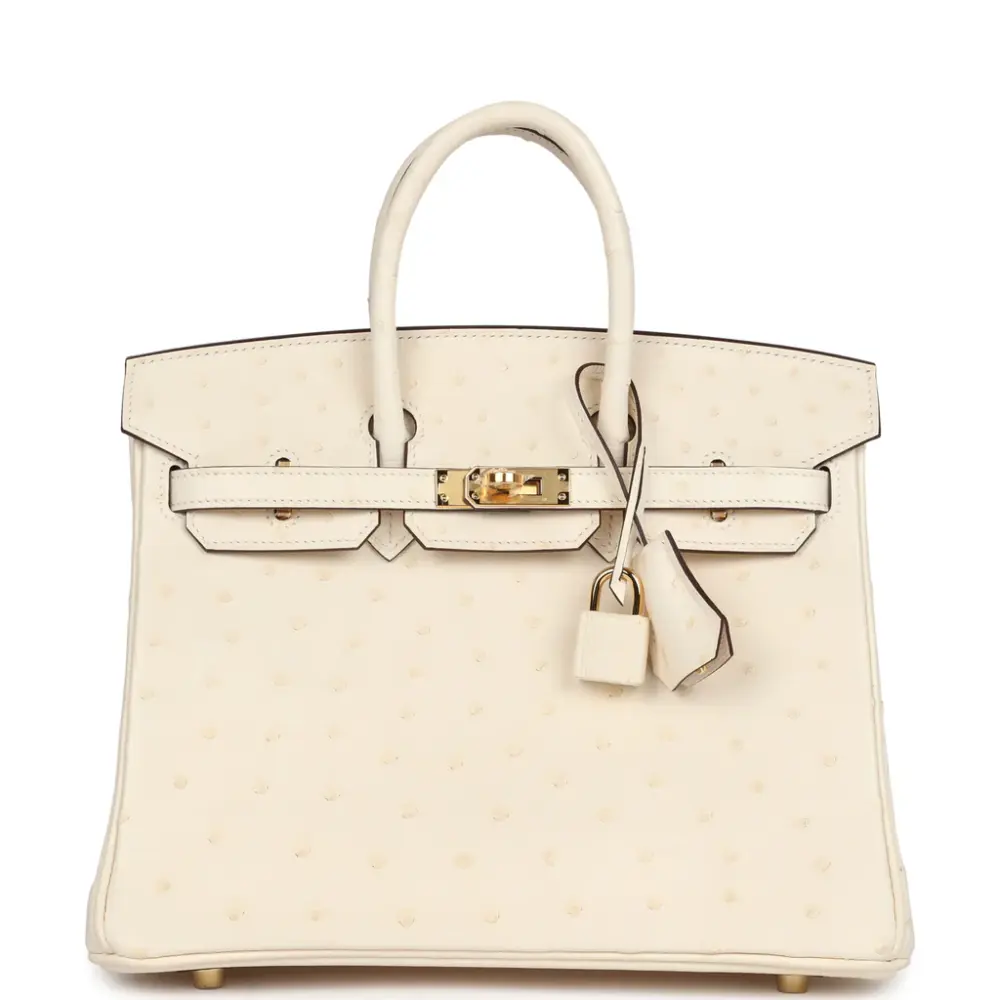
The Canvas: Nata, A Shade of Pure Elegance
Color is the soul of a bag, and the choice of "Nata" is a masterstroke. In the Hermès color wheel, Nata is a creamy, almost white beige. It is a "warm undertone" that exudes purity and sophistication, avoiding the starkness of pure white while maintaining a luminous, ethereal quality. This delicate hue is a testament to the collector's refined taste; it is a color that demands a certain confidence to carry, yet its neutrality ensures it remains timeless and supremely versatile. It is a shade that captures light beautifully, allowing the unique texture of the material it adorns to become the true star of the composition.
The Material: Ostrich, A Textural Masterpiece
The choice of exotic leather is what elevates this Birkin from the exceptional to the transcendent. Ostrich leather is one of the most coveted and distinctive materials in the Hermès arsenal, prized for its unique aesthetic and remarkable durability. Its defining characteristic is the signature "quill follicle pattern" – small, raised bumps that are the result of the bird's feathers being removed . This pattern is not uniform; it creates a natural, organic texture that makes each bag a singular piece of art. No two ostrich skins are identical, which is a point of pride for collectors who appreciate the individuality of their bag .
The sourcing and tanning process for ostrich is an intricate and demanding craft. The skins, primarily sourced from South African farms, undergo a process of flattening and tripling to protect the integrity of the follicles . The material is surprisingly supple and lightweight, yet it possesses a natural structure that holds the Birkin's iconic shape flawlessly. On the Nata color, the matte finish of the ostrich leather absorbs and diffuses light in a way that creates incredible depth and dimension. The quill follicles cast subtle shadows, preventing the pale color from appearing flat and imbuing it with a rich, tactile sophistication. This is why the combination of Nata and ostrich is so powerful: the color provides a pristine canvas for the leather's natural, sculptural beauty.
The Accent: Polished Gold Hardware
If Nata Ostrich is the canvas and the sculpture, the Polished Gold Hardware is the frame that brings it into focus. The warm, luminous glow of the gold plating creates a breathtaking contrast against the creamy, matte beige of the ostrich. It is a classic and cherished combination that defines a certain aesthetic of Hermès luxury. The gold hardware is present in all the iconic Birkin details: the padlock and its leather-covered clochette, the keys, the straps, and the engraved plaque. This metallic accompaniment enhances the bag's perceived value, adding a layer of opulence that perfectly complements the exotic nature of the leather. It is the final, essential piece of this luxurious triad.
The Art of Creation: Time, Craftsmanship, and the Human Touch
To understand the value of a Birkin is to understand the artisanal process behind its creation. In an age of mass production, Hermès stands as a bastion of slow, meticulous craftsmanship. Each Birkin bag is the work of a single artisan, a "highly-skilled" craftsman who dedicates up to 18 to 25 hours of their life to its construction. The process begins with the selection of the leather, where artisans meticulously examine the skin for any flaw, setting aside only the most perfect hides.
This dedication to craft is not just a historical quirk; it is a deeply held philosophy that Hermès actively cultivates. In a recent tour of Hermès' newest leather workshop in L'Isle-d'Espagnac, France, Olivier Fournier, executive vice president of corporate development and social affairs, stated, "We have two patrimonies: The Hermès family and the craftsmen. The craftsmen today are the descendants of the craftsmen of 1837" . The house's commitment to its artisans is so profound that it opens roughly one new workshop per year, training new recruits for 18 months to master skills that have been passed down for generations . The workshop itself operates with a "focused silence," where the only sounds are the "brush of fingers against hide, the hush of waxed linen thread pulled taut, the muted tap of a hammer aligning an edge" . This is the sound of a tradition that has remained unchanged for nearly two centuries.
The Signature Saddle Stitch: Strength and Longevity
A cornerstone of this artisanal process is the saddle stitch. This technique, used for over 180 years, involves two needles and a single piece of waxed linen thread that is passed through the same hole in mirrored motions . The result is a seam of immense strength and durability. If one thread breaks, the other remains intact, ensuring the bag's structure will never fail. This hand-stitching is radically different from machine-made seams, which are glued and stitched, making them prone to failure. The Hermès approach allows a bag to be opened up and repaired, meaning it can be restored and passed down through generations, "from grandmother to daughter to granddaughter" . This commitment to longevity and repairability is a profound act of resistance against the disposable culture of modern fashion and a key reason why Brikins are considered legacy investments.
The Epitome of Scarcity and Desire
While the craftsmanship is legendary, it is the deliberate scarcity of the Birkin that fuels its almost mythical status. The production model is "centered entirely on an attentive human pace" . As Fournier candidly admits, "We are fortunate enough to have incredible customers asking for our bags, and we can’t supply the demand. Not because we don’t want to, but because the way we produce our bags takes time. And we don’t want to force the pace, the speed of this development. We make no compromise on quality" . The luxury of a Birkin is not engineered scarcity, but rather a direct consequence of the time—the "slowness"—required to make it . This is why a Birkin is not simply bought; it is offered. You cannot walk into a boutique and purchase one. It is reserved for the house's most loyal clients, a fact underscored by recent controversies, including a class-action lawsuit alleging customers were required to spend heavily on other products before being offered the iconic bag .
An Investment, An Heirloom, A Masterpiece
The Birkin 25 Nata Ostrich with Polished Gold Hardware is the culmination of all these factors. The "25" size is considered by many to be the most practical and desirable, offering a compact, elegant silhouette that is surprisingly capacious while maintaining a perfect, day-to-evening proportion . Combined with the exotic ostrich leather, this bag commands a significant premium over its calfskin counterparts in the secondary market . The Nata color, with its rarity and clean aesthetic, and the warm contrast of the polished gold hardware, make this a grail item for even the most seasoned collector. It is an object that represents not just a purchase, but an appreciation for artistry, heritage, and the enduring power of true luxury.
In a world that moves at ever-increasing speeds, the Birkin 25 Nata Ostrich is a defiant, beautiful constant. It is a monument to the time it took to create, a testament to the human hands that shaped it, and a symbol of a level of elegance that transcends fashion trends. It is, without question, the pinnacle of exotic luxury.
- Get link
- X
- Other Apps


Comments
Post a Comment