The Holy Grail of Pink: A Deep Dive into the Hermès Birkin 30 Rose Indiennes Shiny Porosus Crocodile with Palladium Hardware
In the hierarchy of luxury handbags, the Hermès Birkin sits alone at the apex. Within that exclusive realm, certain combinations transcend mere fashion to achieve the status of collectible artifacts. Among these rarified creations, the Birkin 30 crafted in Rose Indiennes—a pale, ethereal pink—from shiny Porosus crocodile and accented with palladium hardware represents a singular achievement in the art of leather craftsmanship. This is not merely a handbag; it is a "Black Swan" event in the world of luxury collecting, a piece that combines the rarest color, the most coveted skin, and impeccable craftsmanship into an object of profound desirability .
The Ghost Color: Understanding Rose Indiennes
Hermès has produced numerous pink shades over the decades, from the vibrant Rose Shocking to the warm Rose Dragee and the bold Rose Scheherazade. Yet Rose Indiennes stands apart. Described by top-tier collectors and historians as the rarest pink Hermès has ever produced, it is a color of such scarcity that it has earned the moniker "Ghost" color—appearing so infrequently that many newer collectors have never encountered it in person .
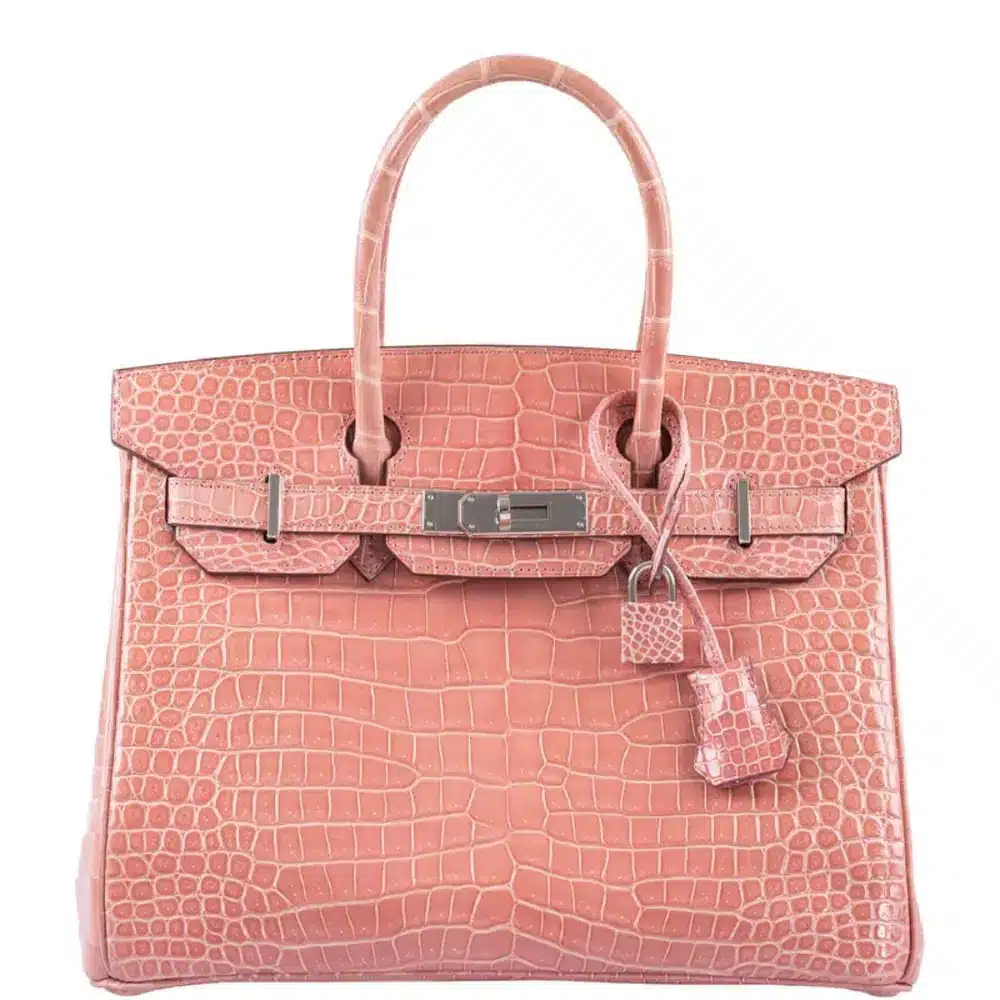
Unlike its pink counterparts, Rose Indiennes possesses a unique character that defies easy categorization. It is a pale, almost fragile pink that carries no discernible purple or orange undertones, setting it apart from shades like Rose Scheherazade which leans toward magenta, or Rose Pourpre with its richer, more complex depth . The color embodies a delicate softness—an ethereal quality that has been described as the spiritual ancestor to Rose Sakura, though significantly rarer .
The technical challenge of producing such a light, nuanced shade on exotic skin cannot be overstated. Pale pinks like Rose Indiennes command a premium over their saturated counterparts precisely because of the extraordinary difficulty in dyeing exotic skins to such light shades without imperfections. The dyeing process requires exceptional skill and control to achieve uniformity while maintaining the natural beauty of the crocodile scales. Any inconsistency becomes glaringly apparent on such a delicate canvas .
The King of Exotics: Porosus Crocodile
The material choice for this exceptional Birkin is equally significant. Porosus crocodile, identified by the caret symbol (^) in Hermès nomenclature, represents the most precious exotic skin the house employs . Sourced from the saltwater crocodile (Crocodylus porosus), this leather is distinguished by its refined, smaller scales that create a more uniform and elegant appearance compared to other crocodilian leathers .
The "Shiny" or "Lisse" finish adds another dimension to the bag's allure. This high-gloss treatment amplifies the delicate Rose Indiennes pigment, creating a luminosity that has been compared to porcelain . The glossy surface catches light in a way that makes the color appear to shift subtly, revealing new dimensions with every movement. The finish demands the highest quality skins, as any blemish would be magnified by the reflective surface.
The quality of the scales themselves is a testament to the exceptional nature of this bag. In the world of exotic leather collecting, the ideal is described as "Small, Square, and Symmetrical"—referring to the pattern of scales across the bag . A Birkin of this caliber requires skins of the highest grade, where the scale pattern flows harmoniously across the bag's surface, creating a visual rhythm that is both luxurious and aesthetically pleasing.
The Icy Counterpoint: Palladium Hardware
The choice of palladium hardware is a masterstroke of design that elevates the bag's aesthetic to new heights of refinement. Palladium, a precious metal related to platinum, offers a cool, silver-toned finish that serves as the perfect counterpoint to the warmth of the Rose Indiennes skin . This pairing creates what collectors describe as an "icy" aesthetic—cool, refined, and impeccably elegant.
The palladium hardware features the signature Birkin elements: the distinctive turnlock closure, the padlock and keys housed in the leather clochette, and the protective feet that safeguard the bag's base. These elements are crafted with the precision that defines Hermès metalwork, with each piece carefully finished to complement the luxurious exotic skin .
For a bag of this vintage—the 2010 production year is identified by the N Square stamp—the condition of the hardware is remarkably pristine, with protective plastic remaining on the main elements . This preservation is extraordinary for a piece that has passed the decade-and-a-half mark, indicating the careful stewardship of a collector who understood the significance of their acquisition.
The Art of Construction
The Birkin 30 follows the dimensions established for this iconic silhouette: 30 centimeters in width, 22 centimeters in height, and 16 centimeters in depth . These proportions create a bag that is substantial enough to be practical while remaining elegant and proportionate.
The interior, lined in matching Chèvre leather, represents another mark of distinction. Chèvre, or goatskin, is prized for its durability and subtle grain, providing a luxurious complement to the exotic exterior . For a piece of this era, the matching interior lining in a special exotic order was a detail that set truly exceptional pieces apart from standard production.
Each Birkin is hand-sewn according to Hermès's centuries-old saddle-stitching technique, a process that may require up to several days to complete for a single bag . The artisans who craft these pieces are among the most skilled in the world, having undergone years of training before being entrusted with the creation of a bag that may command prices in the six figures .
Market Value and Investment Potential
The market for pink Porosus crocodile Birkins has demonstrated remarkable strength, with these pieces performing as some of the highest-return assets in the exotic handbag market . The Rose Indiennes Birkin occupies the very top of this investment pyramid, combining the rarest color with the most valuable skin.
Auction records confirm the extraordinary value of these pieces. A Shiny Rose Indiennes Porosus Crocodile Birkin 30 with palladium hardware sold at Christie's in 2010 for £68,750 against a pre-sale estimate of £25,000-30,000 . The significant premium above estimate reflects the intense demand from collectors who recognize the rarity of this combination. To place this in perspective, other pink crocodile Birkins from this era—such as the Rose Tyrien—have sold for approximately £25,500, underscoring the exceptional premium commanded by the Rose Indiennes shade .
The investment appeal lies not merely in the material value but in the combination of factors that make this bag so desirable. Pale pink crocodile Birkins are the most coveted within the pink category, with their rarity and the technical difficulty of production ensuring continued demand from serious collectors .
The CITES Consideration
For potential purchasers, it is essential to understand the CITES (Convention on International Trade in Endangered Species) implications of owning such a bag. As a product of Crocodylus porosus, this Birkin falls under Appendix II-B of the CITES regulations . This classification imposes restrictions on the international movement of the bag, requiring export and import permits for cross-border transactions.
The CITES restrictions explain why such bags are often sold with caveats regarding their final destination. For example, the Christie's auction of the Rose Indiennes Birkin stipulated that the lot could only be shipped to addresses within the European Union or collected from the London saleroom . Similar restrictions applied to other exotic Birkins, with some lots being restricted to specific regions .
These regulations do not diminish the value of the bag but rather add a layer of complexity to its acquisition. For collectors who understand and navigate these requirements, the CITES designation serves as further authentication of the bag's provenance and the genuine nature of its exotic materials.
Conclusion
The Hermès Birkin 30 in Rose Indiennes Shiny Porosus Crocodile with Palladium Hardware represents the convergence of multiple rarities into a single object of extraordinary beauty and value. The "Ghost" color that appears so infrequently, the king of exotic skins in its most refined form, the cool elegance of palladium hardware, and the impeccable craftsmanship of a 2010 production piece create a bag that stands as a cornerstone of any world-class exotic collection .
For the collector fortunate enough to acquire such a piece, it offers more than mere ownership of a luxury item. It represents participation in a tradition of exquisite craftsmanship, an investment in a proven asset class, and the possession of an artifact that represents the zenith of Hermès artistry. The Rose Indiennes Birkin is not simply a handbag—it is a piece of fashion history, a "Black Swan" whose appearance in the market is cause for celebration among the world's most discerning collectors.


Comments
Post a Comment